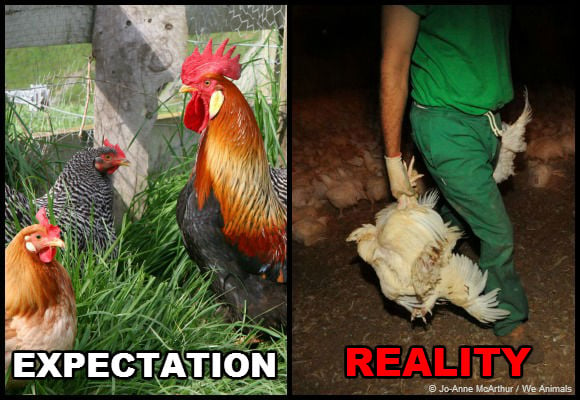
A german documentary about chickens and of course chicken meat consume :
Projekt Huehnerhof
2 episodes - 45 min each - of a test on how much it would cost to raise organic chickens with no genetically modified food, antibiotics and well exercised animals, and if the end consumers would prefer these, even with a much higher price over the regular chickens.
You can see here at day 35 the difference in the cost production (both ''free range'' chickens).
To be considered free-range, chickens raised for meat must have “access to the
outdoors,” which, if you take those words literally, means nothing. (Imagine a shed containing thirty thousand chickens, with a small door at one end that opens to a five-by-five dirt patch — and the door is closed all but occasionally.)
in Eating Animals from Jonathan Safran Foer
Chickens are usually
slaughtered at day 32 - those are the chicken we buy whole. The breast and other partial chicken pieces come usually from older chickens, around 42 days when they have 50x the weight they had after birth (around 2 euros cost production in this documentary's example). They are designed so that they can’t live long enough to reproduce and probably wouldn't be able to (most animals we consume - turkeys, cows, pigs - are all artificially inseminated). This all because consumers demand big breasts and fatty legs. Most of the chicken drop dead from heart attacks because their fatty bodies won't support their own weight, others cannot even stand on their legs or balance themselves on a pole.
They’re babies. That’s how rapidly they’re grown. Salatin’s organic free-range chicken is killed in forty-two days. ’Cause it’s still the same chicken. It can’t be allowed to live any longer because its genetics are so screwed up. Stop and think about that: a bird that you simply can’t let live out of its adolescence.
in Eating Animals from Jonathan Safran Foer
I also found out that it's common practice to distribute
antibiotics in their water in other to prevent diseases rather than cure them. This has increased the bacteria resistance infections in humans.
"the percentage of bacteria resistant to this powerful new class of antibiotics rose from almost zero to 18 percent by 2002. A broader study in the New England Journal of Medicine showed an eightfold increase in antimicrobial resistance from 1992 to 1997, and, using molecular subtyping, linked this increase to the use of antimicrobials in farmed chickens."
in Eating Animals from Jonathan Safran Foer
Also when
testing positive for salmonella - one would think it would make the meat unfit for human consumption well think again - farmers can sell the meat for a lower price to be part of processed foods, such as breaded chicken and/or nuggets.
The above is right for broiler chickens but not so for layer chickens.
If you aren't a farmer, what I've just written probably confuses you. You probablythought that chickens were chickens. But for the past half century, there have actually been two kinds of chickens — broilers and layers — each with distinct genetics. We call them both chickens, but they have starkly different bodies and metabolisms, engineered for different “functions.” Layers make eggs. (Their egg output has more than doubled since the 1930s.) Broilers make flesh. (In the same period, they have been engineered to grow more than twice as large in less than half the time.
Chickens once had a life expectancy of fifteen to twenty years, but the modern broiler is typically killed at around six weeks. Their daily growth rate has increased roughly 400 percent.) This raises all kinds of bizarre questions — questions that before I learned about our two types of chickens, I’d never had reason to ask — like, What happens to all of the male offspring of layers? If man hasn’t designed them for meat, and nature clearly hasn’t designed them to lay eggs, what function do they serve? They serve no function. Which is why all male layers — half of all the layer chickens born in the United States, more than 250 million chicks a year — are destroyed.
Destroyed? That seems like a word worth knowing more about. Most male layers are destroyed by being sucked through a series of pipes onto an electrified plate. Other layer chicks are destroyed in other ways, and it’s impossible to call those animals more or less fortunate. Some are tossed into large plastic containers. The weak are trampled to the bottom, where they suffocate slowly. The strong suffocate slowly at the top. Others are sent fully conscious through macerators (picture a wood chipper filled with chicks). Cruel? Depends on your definition of cruelty.
in Eating Animals from Jonathan Safran Foer
Also to keep production costs low, chickens are slaughtered mostly by automatic machines that most of the time won't stun or slaughter the animals correctly. It's estimated — by representatives of the industry — that in the US about 180 million chickens are improperly slaughtered each year. This translates into, for example, birds going alive and conscious into the scalding tank.
| | Efficiencies of Animal Food Production |
| Milk | Chicken | Pork | Beef |
|---|
lbs. grain/
lb. live weight | 1.0 | 2.5 | 4.0 | 8.0 |
Percent
edible weight | 95% | 55% | 55% | 40% |
lbs. feed /
lb. edible weight | 1.1 | 4.5 | 7.3 | 20.0 |
plant-animal
protein
conversion | - | 20% | 10% | 4%
|
To produce 2kg of chicken you need to invest 5kg of grain and 166 liters of waters. That's only 2kg... imagine how many meals you could cook with 5kg vegetarian ingredients and 166 liters of water... (cruelty free)